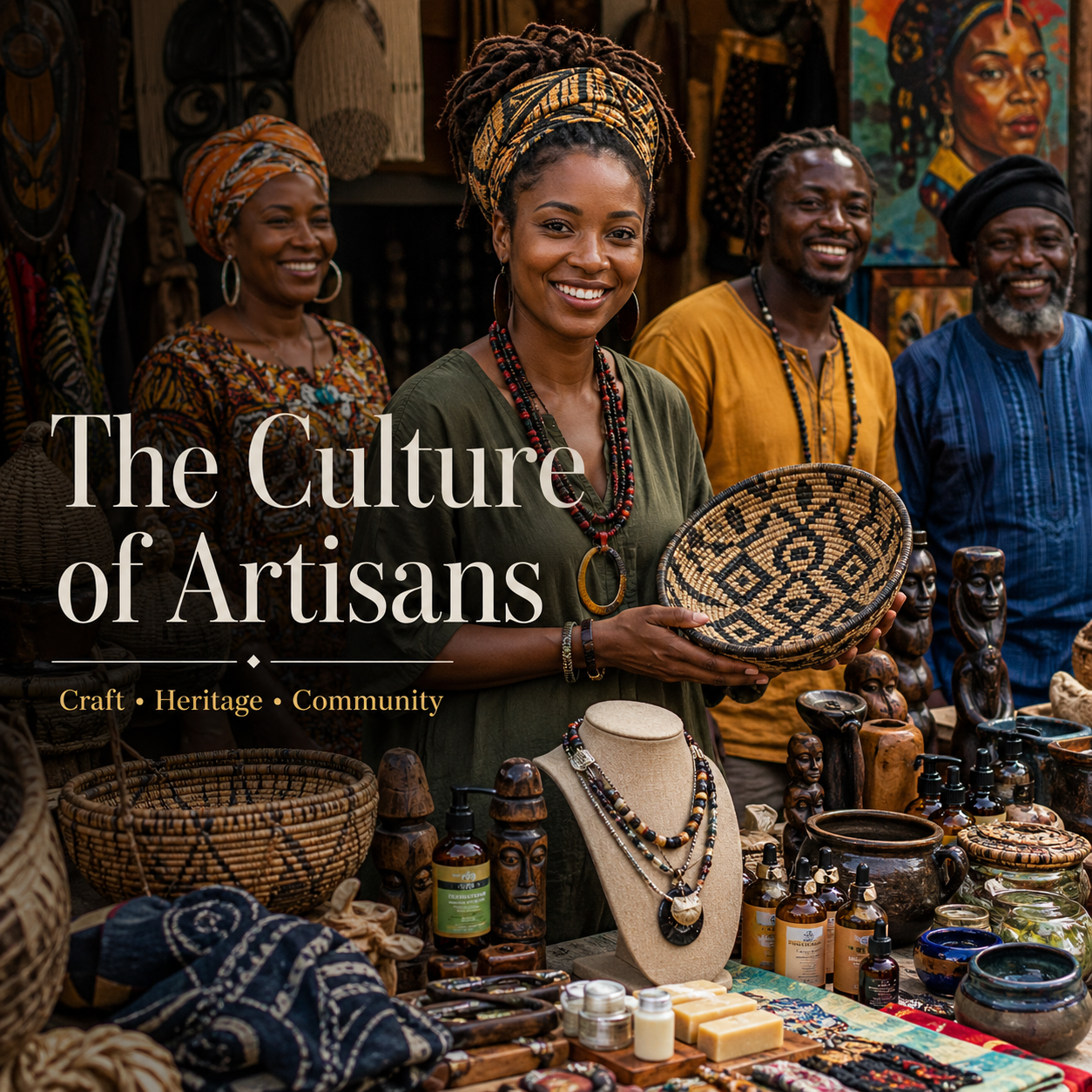
There is something timeless about the work of an artisan.
Long before factories, fast fashion, and mass production, there were hands. Skilled hands. Creative hands. Healing hands. Hands that carved, stitched, wove, painted, moulded, seasoned, wrapped and crafted beauty out of everyday life. Across Africa, the Caribbean, and throughout the diaspora, artisan culture has always been more than trade — it has been identity, survival, expression and legacy.
Artisan culture begins in the home, the village, the market, the community. It lives in the woman weaving baskets with wisdom passed down through generations. It lives in the elder shaping wood, leather, metal or clay into something useful and sacred. It lives in the maker of oils, soaps, jewellery, garments, headwraps, paintings, natural remedies and hand-finished goods. These were never just products. They were stories. They were memory in physical form.
For many of our people, craftsmanship was not a hobby — it was life. It was how families sustained themselves, how culture was preserved, and how beauty was made visible. In times when systems excluded us, artisan culture gave our communities a way to build, trade, create and survive on our own terms. It turned skill into income, and culture into commerce, without losing soul.
And that is what makes artisan culture so powerful even now.
Today, artisans are still here — not as relics of the past, but as living carriers of heritage in the present tense. They are reimagining tradition while staying rooted in it. They are blending ancestral knowledge with modern creativity. They are building brands from handmade products, selling at markets, telling stories through their craft, and creating work that feels personal in a world that often feels increasingly impersonal.
In a time of digital overload and mass production, people are being drawn back to what is real. They want to know who made the item. They want to understand the meaning behind it. They want something with texture, intention, and soul. This is why artisan culture matters now more than ever. It reminds us that craftsmanship is not just about what we buy — it is about what we value.
To support artisans is to support skill, history, enterprise and community. It is to honour the maker, not just the merchandise. It is to recognise that behind every handcrafted product is a person with vision, discipline, and often a long line of inherited knowledge standing behind them.
At GWT Night Market, this spirit matters deeply.
Our artisans are part of a long and beautiful tradition of cultural expression and self-determination. They bring more than stalls and displays — they bring story, pride, originality and presence. Whether they are showcasing handmade jewellery, natural body care, textiles, artwork, home décor, books, wellness goods or cultural crafts, they are continuing a legacy that deserves to be seen, supported and celebrated.
This is what makes artisan culture so alive today.
It is not stuck in the past.
It is evolving.
It is entrepreneurial.
It is expressive.
It is rooted.
It is present.
And when artisans gather in community, something powerful happens. A market becomes more than a marketplace. It becomes a meeting place of vision, talent and heritage. It becomes a living archive of who we are and how we create. It becomes a place where culture is not hidden away — it is on display, in full colour, in full texture, in full truth.
The life and times of artisan culture are not over.
They are happening now.
They live in every maker bold enough to create with intention.
They live in every customer who chooses to support handmade over mass-made.
They live in every community space that opens its doors to local talent and cultural enterprise.
And they will continue to live on, as long as we make room for them.